
Kitchen Lighting Done Right: Task, Ambient, and Accent Lighting Guide
You walk into your kitchen at 6 AM. The space feels cold and unwelcoming under that harsh overhead bulb. Sound familiar?
Proper kitchen lighting isn’t just about seeing what you’re doing. It’s about creating a space that actually makes you want to spend time there.
Most homeowners make the same mistake. They rely on one central light fixture and call it a day. But your kitchen deserves so much more than that builder-grade approach.
In this guide, you’ll discover:
- The three essential types of kitchen lighting
- Where to place under-cabinet lights for maximum impact
- How to position pendants and recessed lighting like a pro
- Real-world solutions that blend function with beauty
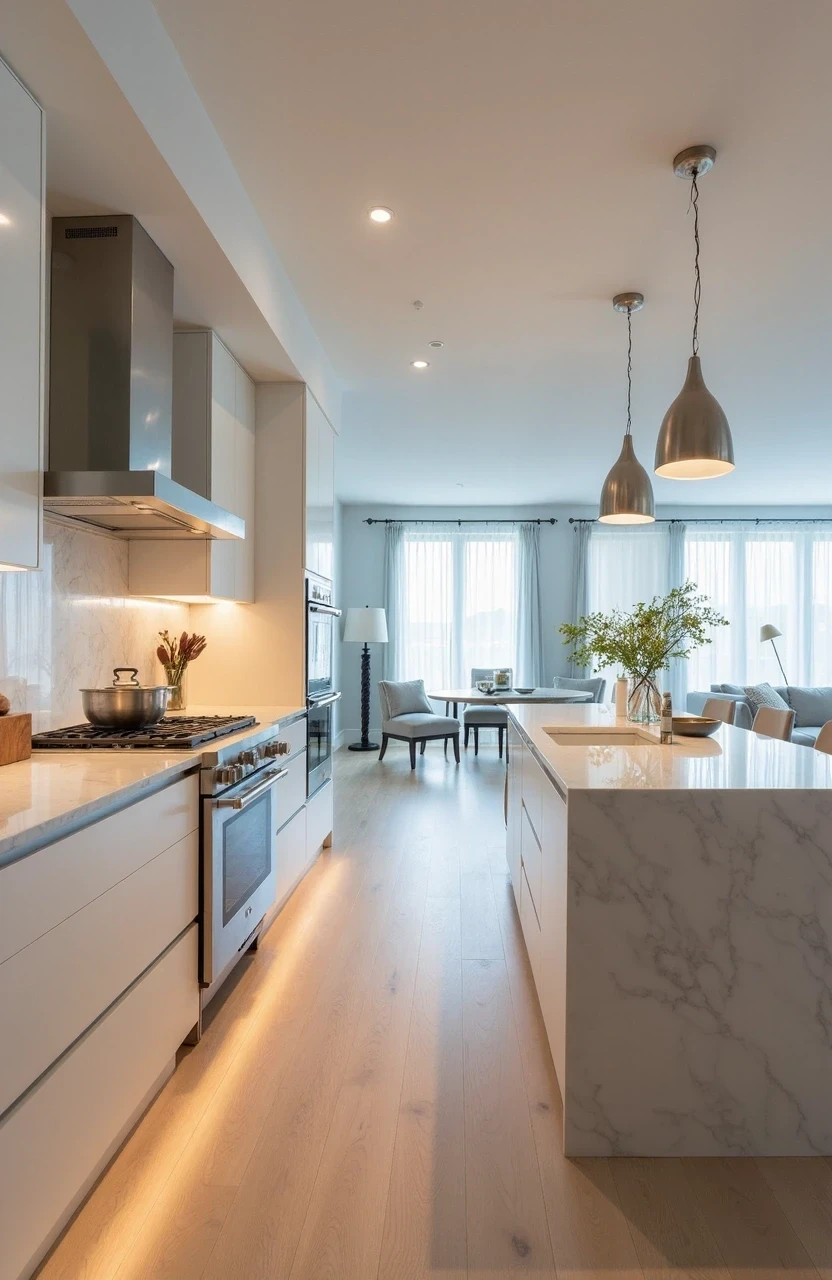
The Holy Trinity of Kitchen Lighting Design
Think of kitchen lighting like getting dressed for a dinner party. You need the basics (that’s your task lighting), something to set the mood (hello, ambient lighting), and a few statement pieces to make things interesting (cue the accent lighting).
Task lighting handles the heavy lifting – chopping vegetables, reading recipes, washing dishes. It’s the workhorse that keeps you from accidentally julienning your fingers instead of carrots.
Ambient lighting creates the overall atmosphere. This is your room’s baseline glow, the difference between feeling like you’re in a sterile laboratory versus a welcoming space where people actually want to gather.
Accent lighting adds personality and visual interest. It’s the jewelry of your lighting design – not absolutely necessary, but it makes everything else look so much better.
The magic happens when all three work together seamlessly. And yes, this means you’ll need more than one light switch. But trust me, your future self will thank you every single morning.

Task Lighting: Where Function Meets Precision
Your kitchen has work zones, whether you realize it or not. The prep area by the sink. The cooking zone around the stove. That corner where you always end up reading recipes on your phone.
Each zone needs its own dedicated task lighting. And here’s where most people go wrong – they think brighter automatically means better.
Under-Cabinet Lighting Placement
Under-cabinet lights are the MVPs of kitchen task lighting. But placement matters more than you might think.
Install them toward the front edge of your cabinets, not the back. This prevents shadows from falling across your workspace when you’re standing at the counter. The light should hit your cutting board, not create a shadow puppet show of your hands.
For LED strip lights, run them continuously across the entire length of your cabinets. No one wants a patchwork of bright and dark spots while they’re trying to work.
Puck lights work best when spaced 12-18 inches apart. Any further and you’ll get those annoying dark spots between fixtures. Any closer and you’re wasting money on unnecessary overlap.
The Kitchen Island Challenge
Islands present their own lighting puzzle. You need enough light to prep food, but you also want the space to feel inviting for casual meals or homework sessions.
Pendant lights work beautifully here, but size and spacing matter. For a standard 4-foot island, two medium pendants work better than one large fixture or three small ones. Space them about 24-30 inches apart, centered over the island.
Hang them 30-36 inches above the counter surface. Any higher and the light becomes too diffused. Any lower and you’ll be ducking around them constantly.

Ambient Lighting: Setting the Mood Right
Ambient lighting is what makes your kitchen feel like home instead of a commercial prep space. It’s the soft, overall illumination that fills in the gaps and creates atmosphere.
Recessed lighting forms the backbone of most kitchen ambient lighting schemes. But here’s where things get tricky – placement can make or break your entire design.
Recessed Lighting Layout Strategy
The old rule of dividing your ceiling height by two to determine spacing? Forget it. Your kitchen isn’t a warehouse.
Start with your task areas and work outward. You want recessed lights to complement your under-cabinet and pendant lighting, not compete with it.
Place recessed fixtures 18-24 inches away from your upper cabinets. Any closer and you’ll create harsh shadows on your cabinet faces. The goal is smooth, even light distribution that enhances your space without creating dramatic contrasts.
For galley kitchens, a single row of recessed lights down the center usually works best. In L-shaped or U-shaped kitchens, you’ll typically need lights in each section, spaced about 4-6 feet apart.
Dimmer Switches: Your Secret Weapon
Here’s something nobody talks about enough – every ambient light in your kitchen should be on a dimmer.
During meal prep, you want full brightness. During a dinner party, you want something more intimate. At midnight when you’re grabbing a glass of water, you definitely don’t want to be blinded.
Dimmers also extend bulb life and save energy. It’s a win-win that costs maybe $20 more per switch.

Accent Lighting: Adding Personality and Drama
Accent lighting is where you get to have some fun. It’s not about illuminating work surfaces – it’s about highlighting architectural features, creating visual interest, and adding layers to your lighting design.
Inside Cabinet Displays
Got beautiful dishes or glassware? Interior cabinet lighting turns everyday items into display pieces.
LED strip lights work perfectly inside glass-front cabinets. Install them along the top of each shelf, hidden behind a small lip or trim piece. The light will wash down over your dishes, creating a warm glow that’s visible even when the cabinet doors are closed.
For open shelving, consider small puck lights mounted under each shelf. They’ll highlight whatever you’re displaying while adding depth to your kitchen’s visual layers.
Toe-Kick and Cove Lighting
Toe-kick lighting might sound fancy, but it’s simply LED strips installed under your base cabinets, right where the cabinet meets the floor. The effect is subtle but dramatic – your cabinets appear to float, and the soft upward glow adds warmth to the entire space.
Cove lighting above your upper cabinets creates a similar floating effect while bouncing soft light off the ceiling. It’s particularly effective in kitchens with 9-foot or higher ceilings.
Both options work best with warm white LEDs (2700K-3000K). Cool white light feels too clinical for accent applications.

Planning Your Kitchen Lighting Layout
Before you start ordering fixtures or calling electricians, you need a plan. And that plan should start with how you actually use your kitchen.
Mapping Your Workflow
Spend a day paying attention to your kitchen routines. Where do you prep vegetables? Where do you read recipes? Which areas feel too dark or too bright?
Create zones based on activity:
| Zone | Primary Task | Lighting Need | Best Solution |
|---|---|---|---|
| Prep Area | Chopping, mixing | Bright, shadow-free | Under-cabinet LED strips |
| Cooking Zone | Stovetop, monitoring | Even, moderate brightness | Recessed + range hood light |
| Cleanup | Washing dishes | Bright task lighting | Under-cabinet + sink pendant |
| Dining Area | Casual meals | Adjustable ambiance | Pendant + dimmers |
Layer Your Lighting Types
The most successful kitchen lighting designs use multiple types in each zone. Your prep area might have under-cabinet task lighting, recessed ambient lighting, and accent lighting inside nearby cabinets.
Start with task lighting – these are your non-negotiables. Then add ambient lighting to fill in the gaps. Finally, sprinkle in accent lighting where it makes sense for your space and budget.

Common Kitchen Lighting Mistakes (And How to Avoid Them)
Even with the best intentions, it’s easy to go wrong with kitchen lighting. Here are the mistakes I see most often.
The Single-Source Trap
One overhead light fixture cannot handle an entire kitchen. I don’t care how big or bright it is. You’ll end up with harsh shadows, uneven light distribution, and a space that feels more like an interrogation room than a welcoming kitchen.
Wrong Color Temperature
Mixing warm and cool white LEDs creates an unsettling, disjointed feeling. Stick with warm white (2700K-3000K) for ambient and accent lighting. You can go slightly cooler (3000K-3500K) for task lighting, but don’t mix dramatically different color temperatures in the same space.
Inadequate Dimming Control
Not everything needs to be on the same switch. Your under-cabinet task lighting probably doesn’t need to dim, but your pendants and recessed lights absolutely should. Plan for separate controls for different lighting types.
Ignoring the Visual Weight
Large pendant lights can overwhelm a small island. Tiny puck lights get lost in a sprawling kitchen. Scale your fixtures to your space. When in doubt, go slightly larger rather than smaller – but not dramatically so.
Bringing It All Together: Your Lighting Action Plan
You’ve got the knowledge. Now you need a plan to make it happen.
Phase 1: Assessment and Planning
- Map your current lighting situation
- Identify dark spots and over-lit areas
- Decide which zones need the most attention
Phase 2: Infrastructure
- Plan electrical requirements (you’ll likely need additional circuits)
- Choose dimmer switches and controls
- Determine fixture mounting locations
Phase 3: Installation Priority
- Start with task lighting (under-cabinet and island pendants)
- Add recessed ambient lighting
- Finish with accent lighting touches
Phase 4: Fine-Tuning
- Adjust dimmer levels for different scenarios
- Replace any bulbs that don’t match your color temperature goals
- Step back and enjoy your beautifully lit kitchen
Remember, great kitchen lighting isn’t about following rules perfectly – it’s about creating a space that works for your lifestyle and makes you happy every time you walk into it.
Lighting Your Way to Kitchen Perfection
Your kitchen deserves lighting that works as hard as you do. With proper task, ambient, and accent lighting working together, you’ll have a space that’s both beautiful and functional. Now stop settling for that sad overhead bulb and start creating the kitchen lighting you actually want to live with.